Languedoc - the home of France's best oysters
Love ‘em or loathe ‘em, you can’t escape ‘em – oysters are a big part of life in the Languedoc, where four out of the region’s five départements are bordered by the Mediterranean.
 Personally, I can take them or leave them, but in France, there’s no avoiding them, particularly during the Christmas and New Year period, when balsa-wood boxes of oysters packed in ice and seaweed are sold in many markets as an essential part of the festivities. Personally, I can take them or leave them, but in France, there’s no avoiding them, particularly during the Christmas and New Year period, when balsa-wood boxes of oysters packed in ice and seaweed are sold in many markets as an essential part of the festivities.
In fact, the French eat oysters all year round (with shallot vinegar and brown bread and butter, if you’re doing it properly), although apparently the best months for huîtres are September to April: after this, the water warms up and the ‘meat’ becomes milky – yuck. So if you’re reading this in March, hurry on down to the coast and sample Languedoc’s briney delights in their prime.
Languedoc - home of French oysters
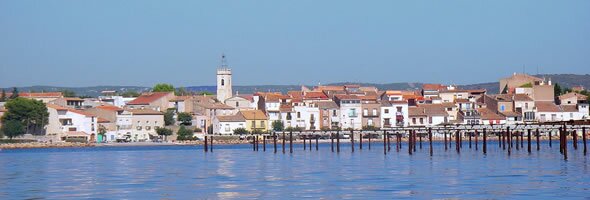
 In the Hérault, if you drive along the N113 coast road from Mèze heading east and look out to sea, you’ll spot a series of odd-looking structures, like square frames on stilts sunk into the seabed, sitting in the waters of the Etang de Thau. They are in fact wooden tables or oyster beds – the place where these slippery, slightly salty and supposedly sex-drive boosting critters are grown. In the Hérault, if you drive along the N113 coast road from Mèze heading east and look out to sea, you’ll spot a series of odd-looking structures, like square frames on stilts sunk into the seabed, sitting in the waters of the Etang de Thau. They are in fact wooden tables or oyster beds – the place where these slippery, slightly salty and supposedly sex-drive boosting critters are grown.
The aphrodisiac association between oysters and sex is probably part-myth, part-cliché, but unlike sex, I find that oysters are rarely a disappointment, and if you eat them in a place like Bouzigues that is renowned for its oyster farms and seafood restaurants with views across the lagoon, instead of a posh Paris brasserie, the experience has an authenticity that adds to the charm.
How to eat them
A French female friend tells me that the right way to eat oysters is with relish (like oral sex, it’s best done with enthusiasm). Don’t pussy-foot around: take the little oyster fork (an implement that is half-fork, half-teaspoon) and push it gently beneath the oyster, to loosen it from its shell. Squeeze on a few drops of lemon juice, or a splash of shallot vinegar (some folk like Tabasco sauce as a spicier alternative). Open your mouth, rest the oyster shell on your bottom lip, and tip your head back with determination. Swallow in a single, sexy gulp - and then smile. Gagging is not an option (go on, you love it really).
Beautiful Bouzigues
 But I digress. Back to Bouzigues. A centre for oyster and mussel production dating back to the time of the Greeks (the earliest fishermen lived in troglodyte caves along the shore), this village located on the Etang de Thau (an étang is a salt water lagoon) between Sète and Balaruc is a good day trip destination. It has a fifteenth century church, an attractive harbour, a narrow sandy beach (scrubby in parts, but good for paddling and picnics), and plenty of cafes, bars and restaurants in which to whet your whistle and fill your boots. We can recommend 'Julie', 'La Table de Marie' and 'Les Jardins de la Mer' – all of which are reviewed in our (simply choose Bouzigues from the drop-down menu). But I digress. Back to Bouzigues. A centre for oyster and mussel production dating back to the time of the Greeks (the earliest fishermen lived in troglodyte caves along the shore), this village located on the Etang de Thau (an étang is a salt water lagoon) between Sète and Balaruc is a good day trip destination. It has a fifteenth century church, an attractive harbour, a narrow sandy beach (scrubby in parts, but good for paddling and picnics), and plenty of cafes, bars and restaurants in which to whet your whistle and fill your boots. We can recommend 'Julie', 'La Table de Marie' and 'Les Jardins de la Mer' – all of which are reviewed in our (simply choose Bouzigues from the drop-down menu).
There's also the Rive de Thau restaurant (41 avenue Tudesq, tel. 04 67 78 31 83) which serves reasonably-priced food with a friendly welcome, or for a swankier vibe on the same street there’s La Voile Blanche (04 67 78 35 77), with its trendy contemporary decor and eight designer bedrooms (handy if you’ve gorged yourself to the point of passing out).
 At the far end of the harbour is a museum (le Musée de l’Etang de Thau) that explains the history and techniques of oyster- and mussel-farming in the area, which is worth a visit (it has fish in tanks which will entertain small children, and lots of sepia photos of Days of Yore for nostalgia freaks). At the far end of the harbour is a museum (le Musée de l’Etang de Thau) that explains the history and techniques of oyster- and mussel-farming in the area, which is worth a visit (it has fish in tanks which will entertain small children, and lots of sepia photos of Days of Yore for nostalgia freaks).
The oyster beds are photogenic (view them by strolling along the path at the edge of the étang), and positively fascinating are the oyster farmers (in French they’re called ostréiculteurs) whose establishments line the lagoon. Although they might not look like the most tourist-friendly of places, these waterfront shacks are where it all happens. I recently visited Les Demoiselles Dupuy, a mas run by charismatic local Romain Dupuy (his father used to be head honcho but now he runs the fabulous Les Demoiselles Dupuy seafood restaurant in Sète – do go if you get a chance).
How oysters are grown
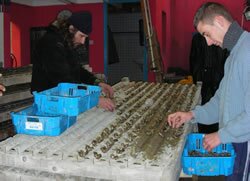 On the day I visited, Romain and his team were busy cementing baby oysters onto lengths of heavy-duty string, laid out on sheets of corrugated plastic, in preparation for plunging them into the waters of the lagoon where they will reach maturity. Oyster farming is much more complicated than I’d imagined (the young oysters have to be positioned in the right way, put in the water at the right time to avoid them getting eaten by fish, pulled out again to be separated as they mature to give them more space to grow, put back in again, and it can take over a year to grow a good-sized specimen) but Romain remains chirpy, despite spending most of his working hours with his hands in cold water, wearing a rubber apron and boots. On the day I visited, Romain and his team were busy cementing baby oysters onto lengths of heavy-duty string, laid out on sheets of corrugated plastic, in preparation for plunging them into the waters of the lagoon where they will reach maturity. Oyster farming is much more complicated than I’d imagined (the young oysters have to be positioned in the right way, put in the water at the right time to avoid them getting eaten by fish, pulled out again to be separated as they mature to give them more space to grow, put back in again, and it can take over a year to grow a good-sized specimen) but Romain remains chirpy, despite spending most of his working hours with his hands in cold water, wearing a rubber apron and boots.
|



 Sightseeing
 Activities
 Tours & Courses





